Showing posts with label books. Show all posts

Monday, April 2, 2012

Children's Books on Multicutlturalism and Diversity


I read a lot of children’s books for class assignments during 2010 - thus the life of an aspiring elementary educator! For one assignment, for my Empowering ESOL Teachers class, I had to read and compile a list of 25 books that would express the idea of multiculturalism. Of course, the main thing to include was books that were about different languages and cultures, but, I went further and included books that contained topics such as adoption, disabilities, and different folktales. The following were ones I enjoyed reading, ones I knew kids would enjoy reading too, and ones I could see myself having in my classroom library (providing I had the funds and actual classroom for the library)! I also suggested grade levels and content area in which they could be incorporated into the classroom curriculum.

Click for more info

       1.      Castaneda, O. S. Abuela’s Weave. (1993). New York: Lee & Low Books Inc.
     Abuela’s Weave is a story about a young girl (Esperanza) and her grandmother (Abuela) creating special items and attempting to sell those items at the village square, in the midst of other sellers. It’s a great picture book for a lesson on Guatemala. Grade: 3. Content Area: Social Studies.

Click for more info
        2.      Cheng, A. (2000). Grandfather Counts. New York: Lee & Low Books Inc.
     Grandfather Counts is a story about a grandfather (Gong Gong) moving in with his daughter’s family in America and bonding with one of his grandchildren (Helen). Together, through counting, Gong Gong and Helen put aside the language barrier and learn each other’s language. It’s a nice story about adapting to a different language and overcoming the obstacles through simple things. It's a great story when doing a lesson about people from China coming to America and finding simple ways, like counting, to make things simpler with language. Grade: 3 – 4. Content Area: Language Arts.

Click for more info
3.      Chocolate, D. (2009). El Barrio. New York: Christy Ottaviano Books.
     El Barrio is a story of a young boy who gives a tour of his neighborhood and shares the town’s Latino culture while everyone gathers to celebrate his sister’s quinceanera birthday party. This story is good for discussing the Hispanic culture all around us. Grade: 2 – 3. Content Area: Social Studies.

Click for more info
      4.      Chocolate, D. (1995). On the Day I Was Born. New York: Scholastic Inc.
     On the Day I Was Born is about the birth of a newborn baby boy, and the traditions his family did to celebrate the news of his birth. This short picture book is great for grades K-2. Because the book is about African traditions, it would be good for a social studies lesson on customs. Grade: K-2. Content Area: Social Studies.    

Click for more info
      5.      Choi, S.N. (1997). Yunmi and Halmoni’s Trip. Boston: Houghton Mifflin Company.
     Yunmi and Halmoni’s Trip is about a young girl (Yunmi) who travels back to Korea with her grandmother (Halmoni) for a quick visit. At first, she enjoys seeing relatives and playing with cousins, but she soon fears that her grandmother will enjoy staying in Korea and will not want to go back to New York to live with her and her parents. Grade: 3. Content Area(s): Language Arts/Social Studies.    

Click for more info
       6.      Choi, Y. (2001). The Name Jar. New York: Alfred A. Knopf.
     The Name Jar is about a young girl (Unhei) who feels embarrassed about using her Korean name in America because she feels that people will make fun of her. On her first day at school, she tells her classmates that she has no name, therefore her classmates decide to use a glass jar and fill various names in it for her to choose one as her new name. Considering each one, she soon realizes that she likes her regular Korean name and, with the help of a new friend (Joey), she decides to keep it and embrace it.  This is a great book that teaches the value of our given names. Grade: 3. Content Area: Language Arts.   

Click for more info
    7.      Cook, M. (2009). Our Children Can Soar: A Celebration of Rosa, Barack, and the Pioneers of Change. New York: Bloomsbury U.S.A Children’s Books.
     Our Children Can Soar is a short picture book which celebrates several African American victories as ways of paving the way for each other. Several people mentioned in the book are George Washington Carver, Jesse Owens, Jackie Robinson, and President Barack Obama. This special book would be good for lessons on any of the select people mentioned in the book, or for a social studies lesson during February’s Black History Month. Grade: 2-4. Content Area:  Social Studies.   

Click for more info
     8.      Dahl, M. (1998). Countries of the World: China. Minnesota: Capstone Press.  
     Countries of the World: China is a short nonfiction book about the country of China. The book gives the reader a tour of the country by showing certain sight seeing places, information about the home and school life of children, information about the currency and the flag, and even learning words spoken in Chinese. It is a good book for a lesson on China. Grade: 2-3. Content Area: Social Studies.    

Click for more info
     9.      Friedrich, M. (2004). You’re Not My Real Mother! New York: Little, Brown, and Company.
     You’re Not My Real Mother! is about a small girl who tells her adoptive mother that the mother is not the girl’s real mother because they have different skin colors (the girl is either African American or Hispanic, while the mother is Caucasian). The mother then responds by giving logical reasons why, even though she doesn’t look like her daughter, she is the girl's real mother, because of all things she does for the girl, and because the love is real. While this book is appropriate for grades K-2, in celebration of uniqueness and diversity, I would have to check with the parents before sharing it to the class - in the event that there could be children in my classroom who are adopted but whose parents never mentioned it. Grade: K-2. Content Area: Language Arts.    

Click for more info
     10.  Geeslin, C. (2007). Clara & Senor Frog. New York: Schwartz & Wade Books.
     Clara and Senor Frog is about a young girl (Clara) who thinks her mother’s boyfriend looks like a tall frog (whom she refers to Senor Frog). However, as time goes by, she and Senor Frog bond with the shared ambition of painting. It is a nice book to integrate Latino art into an art lesson or language arts lesson. Grade: 2-3. Content Area: Language Arts/Art.   

Click for more info
     11.  Girard, L. W. (1989). We Adopted You, Benjamin Koo. USA: Albert Whitman & Company, Niles, Illinois.
     We Adopted You, Benjamin Koo is a loveable story about a boy (Benjamin Koo Andrews) who narrates his life up to fourth grade. He discusses the issue of finding out he was adopted and came from Korea, being made fun of at school because of his appearance, and gaining a sister from Brazil. This great picture book is great to have when discussing a lesson about Korea and how sometimes kids are adopted from different countries. Grade:  3-4. Content Area: Social Studies.   

Click for more info
     12.  Guback, G. (1994). Luka’s Quilt. New York: Greenwillow Books.
     Luka’s Quilt is about a small girl (Luka) whose grandmother (Tutu) makes a quilt that displeases the girl because it has no color on it.  The displeasure continues until Tutu decides to add a special gift to the quilt, and Luka decides to love the quilt with and without the added colors. It is a good book when discussing the Hawaiian culture. Grade: 2-3. Content Area: Language Arts/Social Studies.   

Click for more info
    13.  Hector, J. (2008). The Little Matador. New York: Hyperion Books for Children.
     The Little Matador is about a young matador whose ambition is to draw instead of being a bullfighter. This cute short picture book is good to show that all children have a purpose and should follow their goals, the things they are good at doing. Grade: K-1. Content Area: Language Arts/Social Studies/Art.    

Click for more info
     14.  Kroll, V. (1992). Masai and I. New York: Four Winds Press.
          Masai and I is about a small girl who imagines what her life would be like if she were in the Masia tribe in East Africa. In the story, she imagines how her home and environment would be like, what she would eat, what kind of jobs her parents would have, etc. I think this book is good for teaching a social studies lesson on Africa. Grade: 3. Content Area: Social Studies.

Click for more info
     15.  Mannis, C.D. (2002). One Leaf Rides the Wind. New York: Viking.
     One Leaf Rides the Wind is a picture book of Japanese haiku seen through the eyes of a small Japanese girl. The reader is shown several surroundings (ten total, with each page a numbered location) of Japanese culture as the girl shares special places within her garden. It is great for grades K-2: a grade K mathematics lesson, and grades 1-2 language arts lesson. Grade: K-2. Content Area: Mathematics/Language Arts.  

Click for more info
     16.  Mara, W. (1999). Countries of the World: Cuba. Minnesota: Capstone Press.
     Countries of the World: Cuba is a short nonfiction book which explores the country of Cuba by giving information of the country’s flag and currency, the home and school life of Cubans, particular foods and animals, and cities and customs within the country. This book is good for a lesson on the country of Cuba. Grade: 2-3. Content Area: Social Studies.    

Click for more info
    17.  Miller, J. (1996). American Indian Games. USA: Children’s Press.
     American Indian Games is a short nonfiction book about the kinds of activities young American Indian children participate with their friends and family. The book explores the classic toys and games from pastime, and shows the kinds of games American Indian children play today. This is a great book on Native American culture. Grade: 2-3. Content Area: Social Studies.    

Click for more info
     18.  Patz, N. (2003). Who Was the Woman Who Wore the Hat? New York: Dutton Books.
     Who Was the Woman Who Wore the Hat? is about a narrator wondering about a particular hat at the Jewish Museum, and guessing what kind of person the wearer of the hat could have been. This would be a good book when doing a subject on the Holocaust.  Grade: 4-5. Content Area: Language Arts/Social Studies.    

Click for more info
     19.  Recorvits, H. (2003). My Name is Yoon. New York: Frances Foster Books.
     My Name is Yoon is a story about a small Korean girl who moves to America with her family and struggles to make friends and accept that her name is written “Yoon” in English. In retaliation, she chooses to write her name as CAT, BIRD, and CUPCAKE (things she finds interesting) in school until she learns to value the use of written English, and makes new friends at school. This picture book is great when discussing Korea or teaching about the special meanings of our names in different languages. Grade: 1-2. Content Area: Language Arts/Social Studies.

Click for more info
         20.  Seuss, Dr. (1961). The Sneetches and Other Stories. New York: Random House.  
     The Sneetches is a classic Dr. Seuss tale about two different groups (Sneetches with stars on their bellies, and Sneetches without stars on their bellies) who compete to be superior and unique. When their attitudes create chaos, they realize that they need to accept each other and cherish the unique features they both share. The book is perfect for a lesson on togetherness and diversity. Grade: 1-5. Content Area: Language Arts.

Click for more info
     21.  Shally, C. (2007). Since We’re Friends: An Autism Picture Book. Arkansas: Awaken Specialty Press.
     Since We’re Friends is about a boy who has a friend (Matt) with autism. The boy narrates their friendship and shares certain moments that causes Matt’s behavior to change into small fits of emotion. This book is good when teaching diversity in race and in disability. Grade: 2. Content Area: Language Arts.

Click for more info
     22.  Thomas, P. (2000). Don’t Call Me Special: A First Look at Disability. New York: Barron’s Educational Series, Inc.
     Don’t Call Me Special takes a look at several kinds of disabilities that children may have (from physical to mental) and  questions the reader to reflect about themselves and if they can relate to the situation. This picture book is good for teaching about diversity. Grade: K-2. Content Area: Language Arts.

Click for more info
      23.  Volavkova, H. (1993). …I Never Saw Another Butterfly: Children’s Drawings and Poems from Terezin Concentration Camp, 1942-1944. New York: Schocken Books.
       I Never Saw Another Butterfly is an intimate compilation of drawings and poems of the Jewish children who were kept in the Terezin concentration camp. This would be a good book when doing a subject on the Holocaust, though I probably would inform the parents before choosing to read a few selections. Grade: 4-5. Content Area: Language Arts.

Click for more info
     24.  Walker, A. (2007). Why War is Never a Good Idea. New York: Harper Collins Publishers.
     Why War is Never a Good Idea is a serious story about how war is a universal language, and that no matter which part of the world war happens, war is destructive. It is a great book, with a great message, but because of the seriousness of the message and content, I would share this book only after notifying the parents beforehand. Grade: 4-5. Content Area: Language Arts/Social Studies.

Click for more info
    25.  Wojciechowska, M. (2007, republished). Shadow of a Bull. USA: Aladdin Books.
     Shadow of a Bull is about a young boy (Manolo Olivar) who wants to be a normal boy who has no fears, but the whole town of Arcangel expects him to become a great bullfighter like his late father. I think this novel can be used during a lesson about the country of Spain or revolving around its importance of bullfighting in their culture.  Grade: 4-5. Content Area: Language Arts/Social Studies.

Tuesday, March 27, 2012

Annotated Book List of Newbery Award Winners

   
     Back in Spring 2010, when I took the class Methods of Teaching Language Arts at my university, I was assigned to a list of Newbery Award Winning books between 1956 to 1966. My assignment was to read at least five books from a list of choices between the given year-range and write an annotated bibliography detailing a synopsis of the books and my opinion of the books. Though the following books are over 50 years old, they still have decent qualities relevant to today's readings...even if there may have been one or two books that weren't my favorite. I definitely feel that just because a book is old doesn't mean it is outdated and can't entertain today's youth. Certainly, if a story is told in such a way that it can still impact readers after 50 years, then it deserves to stay alive in the hearts of new readers! The following were my five choices.


1.      Carlson, N.S. (1958). The Family Under the Bridge. USA: Harper & Row Publishers.
     Set in Paris, France, the story of The Family Under the Bridge is about an old tramp, named Armand, who discovers that a mother (Madame Calcet), her three children (Suzy, Paul, and Evelyne), and their stray dog (Jojo) are living under the bridge he usually visits. Armand becomes attached to the family and takes the children (while the mother is at work) on a tour around Paris to see all of the Christmas sights, and to beg people for money. As Christmas approaches, what the kids long for the most is for a warm, stable home to live in with no worries of being separated from their mother and their newly inducted grandfather (Armand). Therefore, it is up to Armand to make sure that the kids will not be disappointed by their wish.
     The Family Under the Bridge is a heartwarming story that has likeable characters and sends a message of love and honor. The story even has Christian undertones that even a secular reader would not mind being present. I would definitely have this book in my classroom library, and while I think it could be appropriate for all levels, I will tag this book as a great 3rd grade novel.

2.      Enright, E. (1957). Gone-Away Lake. USA: Harcourt Brace Jovanovich, Publishers.
     Gone-Away Lake is about a young girl (Portia Blake) and her brother (Foster) traveling to her cousin (Julian Jarman)’s house for the summer and embarking on a strange discovery. Portia and Julian go exploring in the woods one day when they come across a swamp surrounded by crumbled houses. It turns out that an elderly brother and sister of old time still live in two of the run-down houses and informs the kids that the swamp use to be a beautiful lake inhabited by several families. Intrigued by the swamp’s unique characteristics and the discovery of two very unique acquaintances, Portia and Julian agree to keep their new discovery a fun little secret until Foster becomes suspicious and chooses to follow them one day.
     Gone-Away Lake is a fascinating story that is very well written and has characters whom any reader will immediately want to become invested into. I definitely would consider having this novel in my classroom library. I tag this book appropriate for children between grades 4th and 5th.

3.      Gipson, F. (1956). Old Yeller. New York: Harper Trophy.
     Old Yeller is a frontier story about a boy who learns to love a dog at a terrible price. While Papa is away, young Travis has to become the man of the house and watch after his baby brother and mother while doing the chores. One morning he discovers that a thief has stolen his family’s pig meat, only to discover that a yellow-looking dog was the culprit. Unimpressed by the dog (and originally against his inclusion into the family), Travis eventually learns to accept the dog and value him as a loyal friend and protector. However, the dog’s loyalty and bravery leads to Travis having to make a hard decision when a rabid wolf endangers the family and Old Yeller is left injured from his battle wounds.
     You. Will. Cry. This age-old classic is notably famous for its final chapters, which will tear the reader’s heart to pieces after spending the entire story seeing the relationship between Travis and Old Yeller form and grow. The novel is a great source to use when teaching a social studies lesson of the frontier life, and it is a great source to admire the simplicity of the language used in the story (for that reason, I recommend teachers read in a southern accent). I definitely will try to have this in my classroom library, and I think it is most appropriate (because of the themes and content) for 5th through 7th grade students.

4.      L’Engle, M. (1962). A Wrinkle in Time. USA: Farrar, Straus, and Giroux.
     A Wrinkle in Time is a science fiction novel about a girl (Meg Murray), her younger brother (Charles Wallace), and a friend (Calvin O’Keefe) joining three strange beings (disguised as Mrs. Whatsit, Mrs. Who, and Mrs. Which) on a cosmic search for her father. While traveling through time and space, and venturing onto strange planets and worlds, the three children discover that Meg’s father is being held captive by a dark, evil force that plans to engulf their own planet (earth). Though Meg has insecurities, she must face them in order to save her father, but more importantly, also save Charles Wallace from the evil entity known as IT.
     A Wrinkle in Time has interesting characters that invites the reader to become invested in them, and the story has a nice flow in structure. However, I  personally did not like the reference in the story that seemed to include all of the other religions on the same scale as Jesus and Christianity – it seemed to mold them all together in an accepting manner. With that said, I tag this book appropriate for the 5th to 8th grade level.

5.      Wojciechowska, M. (1964). Shadow of a Bull. New York: Atheneum Macmillan Publishing Company.
     Shadow of a Bull is about a young boy (Manolo Olivar) who lives under his late father’s shadow. The whole town of Arcangel expects Manolo to become a great bullfighter like his father was, and he instantly becomes the town hero, though all he wants to be is a normal boy who has no fears. Though he agrees to enter a bullfighting contest, he soon discovers that his destiny probably lies outside of the bullfighting ring, and worries that he will end up disappointing his mother and townspeople by failing at what his father was best known for – being the best bullfighter around.
     Shadow of a Bull is a great novel to have in a classroom library, and I hope to have it in mine. The story was great, and the characters were all top-notch. From the very beginning, the reader cares for Manolo and hopes he succeeds in whatever he wants to do. I tag this novel as being appropriate for children in grades 4th and 5th.  

Thursday, February 16, 2012

Storybook Activity Idea

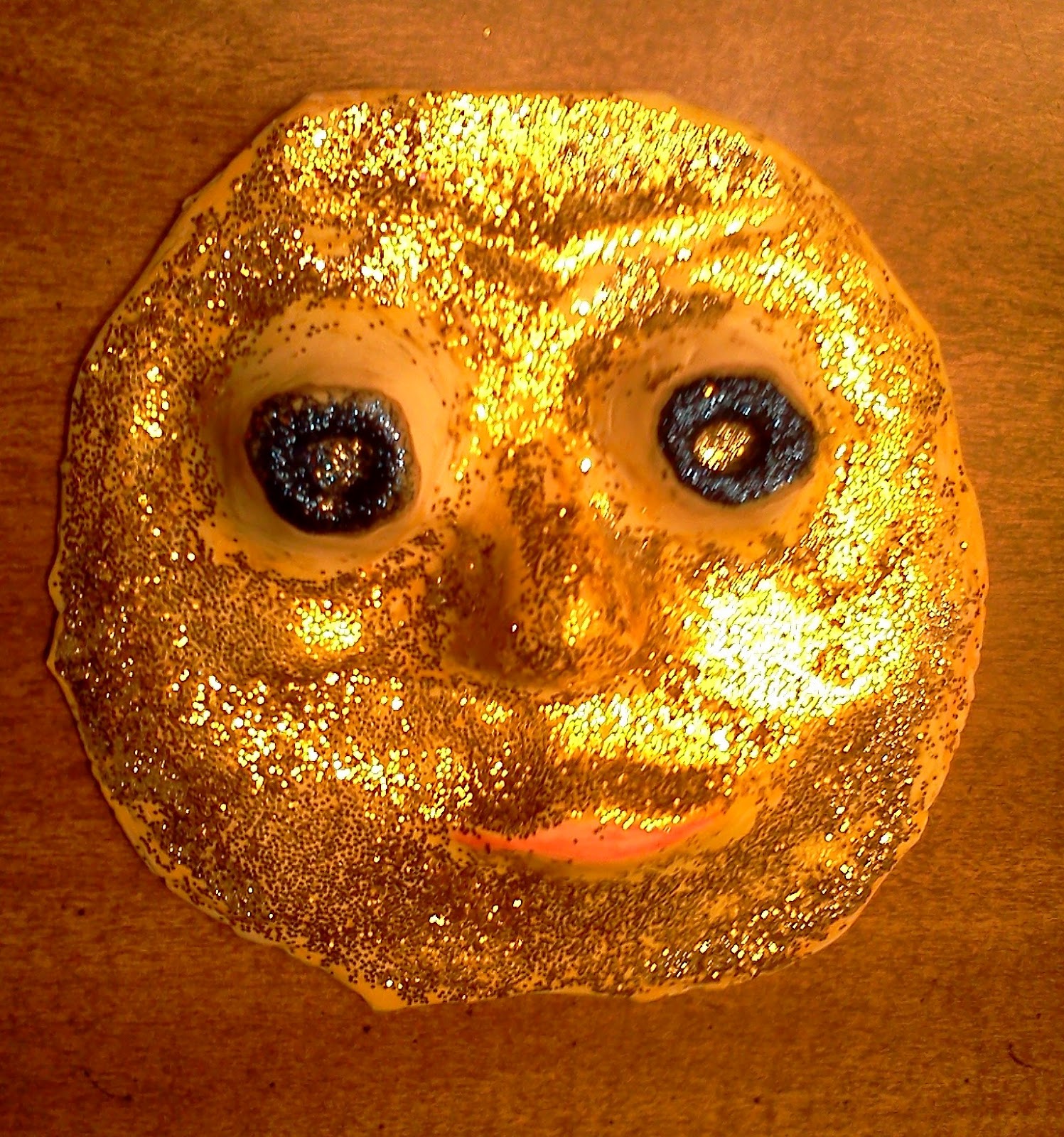
I recently read the book The Invention of Hugo Cabret by Brian Selznick and really enjoyed the story. But above all, I really enjoyed the artwork. My favorite part in the book happens somewhere in the middle, where Hugo recalls his father's favorite film, A Trip to the Moon, by Georges Melies. In the film, a group of travelers take a rocket ship to the moon and encounter strange inhabitants. In one particular scene, the rocket ship travels directly into one of the eyes of the Moon. I don't know why, but I simply love the still from the movie that depicts this scene. It inspired me to do an activity that showcases this particular scene in the book. 

All I did was use some easy molding clay (the kind you can find at any store in the arts & craft sections) and molded a flat circle, then molded a nose and two eyes and a mouth. Afterwards, I baked it in the oven for about 19 minutes and let it cool. Then, I decided on how I wanted to color it. After several trials and errors, I eventually went with a yellow exterior, because that's how the image of the moon looks like in the photo I based it on. Then, I covered the face with glue from a glue stick and then layered it with gold glitter. The eyes also were originally colored brown, but it didn't look that well, so I re-colored it with blue liquid glitter. Additionally, I made a background to go with it. All it consists of is black construction paper with a rocket ship and stars drawn around a space I designated for the moon. Here's how the finished product looks:


     The activity got me thinking about how cool it would be if I, once I have my own classroom, were to do something like this with my students. I really think that would make Language Arts more enjoyable - diving into stories with our students and then, once done, allow students to recreate their favorite parts by either acting out scenes, or drawing their favorite moments, or even creating scenes from the stories by using clay and making a diorama! This is simply what I did: I took a favorite part from a book I recently read, and I recreated my own interpretation. I really think students would enjoy this approach, and it would enhance their reading experience. Of course, this would also be a ripe opportunity to collaborate with the art teacher too! If there are worries that a regular teacher couldn't pull this off in his/her classroom, then collaborate with the art teacher to allow this sort of activity to be done!

     I remember being in 5th grade and having the chance to recreate a scene from one of the stories we were reading in class. The story was Summer I Shrank My Grandmother by Elvira Woodruff, and we were assigned, in class, to choose one of our favorite parts and illustrate the scene. One of my favorite parts was when the granddaughter woke up one morning to find that her grandmother had shrank to a tiny toddler, so I remember drawing the grandmother as a little girl with red curly hair, with a red wagon! 

     I see no wrong in doing this in a classroom. I mean, I look back on the times my teachers used these moments as teachable experiences and I yearn to have those same moments with my own students. That's one of the reasons I wanted to be a teacher in the first place! I understand that, in a world where we have to deal with teacher accountability and high stakes testing, it can be frustrating to abide by our requirements while also trying to fit in enjoyable moments...but we shouldn't sacrifice the enjoyment just to have more "learning", especially if the enjoyment enhances the learning experience!


     Well, to get off of that unintentional soap box, I close this entry with a look at the clip of Melies' film A Trip to the Moon, which inspired part of Hugo's storyline and my art activity. Oh, and don't feel shy of checking out The Invention of Hugo Cabret or Summer I Shrank My Grandmother from your local library!...They are two really good books!


Thursday, January 26, 2012

My Book: The New Day

So, a long time ago, I posted a preview of my book, The New Day, on here when it was first published. I took it down due to insanity because I was afraid of my stories getting stolen and claimed as other people's (it's a fear I have). But, I've come to the realization that that idea simply isn't fair. It's not why I made the book. It's not why I posted most of those poems and short stories on this blog. I made those things so that others can enjoy them (if they did) and so that they can be helpful to others. Some of those poems dealt with feelings related to personal trials I've been through, and just writing most of them really have helped heal some deep wounds. And almost all of them deal with my faith and the need I yearn for in God and Jesus Christ. Even today, I look back on some of the poems and remember certain phrases and I feel better about a situation that I may be going through.

For example, I wrote the poem "I Will Worship You" a while back to combat against things I feared. To this day, there's a line that goes, "Stormy weather may make me frown, but my heart still wears it's crown. So long fear, you can't hold me down! With all my life, Lord, I will trust in you!"

I can't tell you  how at ease I feel when I quote that to myself to this day! I was once told by a friend that reading one of my poems really was empowering. That compliment gave me the strength to continue to share them with easy access. So, that is my plan. They'll go back up; on here or on my other blog, if they're not already. Because, I thank God for giving me this gift to write. Writing is my passion. It's one of my dreams (apart from teaching the little ones). And I have so many stories to tell! (I have a calling in me to reach young readers and young adults and change the way kids are being marketed in the publishing business, but, shhh, it's a secret!).

Nonetheless, I recommend, if you like the poems or short stories I've posted here, you might like to have them in book form. I, of course, won't receive any revenue (by choice, because it's not set up that way, and I don't want it any other way). You'd only be purchasing to have Blurb make you a book copy. By all means, though, print them off here if you like them (but some of them are revised in the book form). However, as someone who purchased the book form, I can say that I really love having them in a book form, and all under $10 (when you consider processing and shipping, which is cheap for a Blurb book)! I personally have the soft cover version, because I wanted to see my works in a book form (aside from being handwritten in a journal), and I just love the cream-colored paper that comes with the book form. Plus, the picture on the front and back cover was taken at a wonderful place I worked at, so it makes it more special, to me at least!

The point of this random blog entry, if you've enjoyed my poems or short stories like I have, thank you! And, if you'd like them in a book form (for your own enjoyment; I won't see any revenue from any sales) then you can click on the link within the book preview down below.

I know this was random, but this was on my heart so I thought I'd mention it here!

Wednesday, January 25, 2012

The Hunger Games' Story

It has almost been a year since I found out about The Hunger Games by Suzanne Collins. When I worked at my University's library, I remember seeing the book and it's sequels on the shelf countless times (and I possibly even checked it out to patrons many times; I think). However, it wasn't until news of a movie being made from it that I really started to take interest in this series.


Of course, it wasn't just because there was going to be a movie of this story; it was also because of the hype from people I knew who had been fans of the story for a while. That revived hype got me interested in reading the first book during the summer holiday.


You see, ever since J.K. Rowling finished the final Harry Potter book, I've been looking for a series that has an engaging storyline for its characters. I tried to "get into" the Twilight series (don't judge me!) but, by chapter ten, I just couldn't stand most of the characters and their descriptions and habits. (My sister said it was because I wasn't a girl. My feelings about gender discrimination aside, as someone who loves a good story, I don't think I didn't like the Twilight novel just because I wasn't "a girl.") So, after that failed attempt, I was kind of hesitant about reading another series (from an author I never knew of) that consisted of a fan base largely made of females. However, I love a good story, so I eventually checked out The Hunger Games last summer. (The summer time is usually the time I focus on reading new stories. Most of the time.)


My initial thoughts of the book were positive ones. It does contain a great storyline, and its characters are believable and experience a life in a world in need of a savior (go Katniss and her gang of people!). I like how it reminded me of the short story "The Lottery" by Shirley Jackson (the way of choosing Champions), and a little bit of the television show LOST (the jungle scenes). Sure, being male, there were times, when Katniss played on the girlish flirting for the cameras, that made me cringe a little while reading certain scenes, because I knew it was against her character and that she did that to get sponsors. Although, I understand she did that to go with the flow that society expected her to be in this competition. Also, I find it a pet peeve if there are errors in books, and I found several errors in the copy I checked out from my library. (Just a few, near the end.) With that aside, I found it to be a good story. Although, I stopped reading after the first book, because there were other stories I wanted to read, and other things I wanted to do, during the summer before I started my student teaching. However, I really do recommend this story for those interested in a good adventure.


With that said, seeing the trailer for the movie adaptation of The Hunger Games really got me excited about the movie. However, soon after feeling excited, I soon felt sad. I mean, I'm pretty sure I'm not going to see this in the theater, solely because I don't want to be the one male in the room not forced there by his girlfriend. I mean, I am aware it's a story that captured a female fan base (which is wonderful, we need more, better/stronger female characters for young girls/ladies) and some males, but it's the kind of movie you know certain people are going to be squee-ing over solely for the male actors - every series (especially one like this) has those kind of movie-goers. Nonetheless, I will probably, most definitely wait until the movie is on DVD to enjoy it.


Sunday, February 7, 2010

The Reading Corner: Suggesting Books I've Read and Enjoyed

Peace Like a River by Leif Enger

      It's a story about a young boy, Reuben Land, who witnesses miracles through his father during a time of searching for his brother, Davy, who has recently gone on the run after committing murder. This novel covers the topic of faith, miracles, and family strength during moments of hardship and struggle. This novel is well-written and definitely a great novel that demonstrates the message of real miracles and the eternal love of a father. 


The Brother's Keeper by Tracy Groot

      It's a story about James, the half-brother of Jesus, and his siblings having to deal with the changes that Jesus' mission has brought on their lives. They care about Jesus, but they don't know whether they should accept that He is the Promised One from God, or some radical. It's a beautiful story that really brings out the personality and emotions from each individual person in the story (especially James). It's dramatic in certain parts, but there is also comical moments that brings a smile out. I love this book. I don't think I've ever read a fictional book as detailed as this author has done for this story.

Thursday, March 26, 2009